Freezer Repair · Rolling Bay
Frost Sheets in a Sub-Zero Freezer Drawer: Reading the Defrost Circuit
A wall of frost in a Sub-Zero freezer drawer is a defrost fault, a seal fault or a habit — and the three look nothing alike once you know what to check. A field diagnosis from island service calls.
Every winter a run of the same call comes in from the north end of the island: the freezer drawer is full of ice, it has been getting worse for a while, and somebody would like to know whether the unit is finished. It almost never is. A frost sheet is one of the most legible symptoms in built-in refrigeration — where it forms, how fast it comes back and what the compartment temperature is doing alongside it will separate three completely different faults without a single tool.
Where the frost is tells you most of it
Before anything else, look at where the ice actually is. The location is the diagnosis, or most of it.
A hard sheet on the back wall of the compartment is the classic defrost failure. The evaporator sits behind that panel, and in normal operation a heater melts the accumulated frost off it several times a day, sending the water down a drain. When that cycle stops, the ice never leaves. It grows backwards from the evaporator until it presses through onto the wall you can see.
Ice along the drawer slides and around the opening is a sealing problem. Warm room air is getting in at the perimeter, hitting cold metal and condensing where it lands. The evaporator is usually fine.
A loose, snowy dusting over the food with no hard ice anywhere is neither. That is moisture that came in with the contents, or a drawer that stands open while somebody decides what to cook. Annoying, not a fault.
If what you have is the first one, the rest of this is worth reading properly.
The defrost circuit, and its three failure points
A defrost cycle has three parts, and any one of them stops the whole thing.
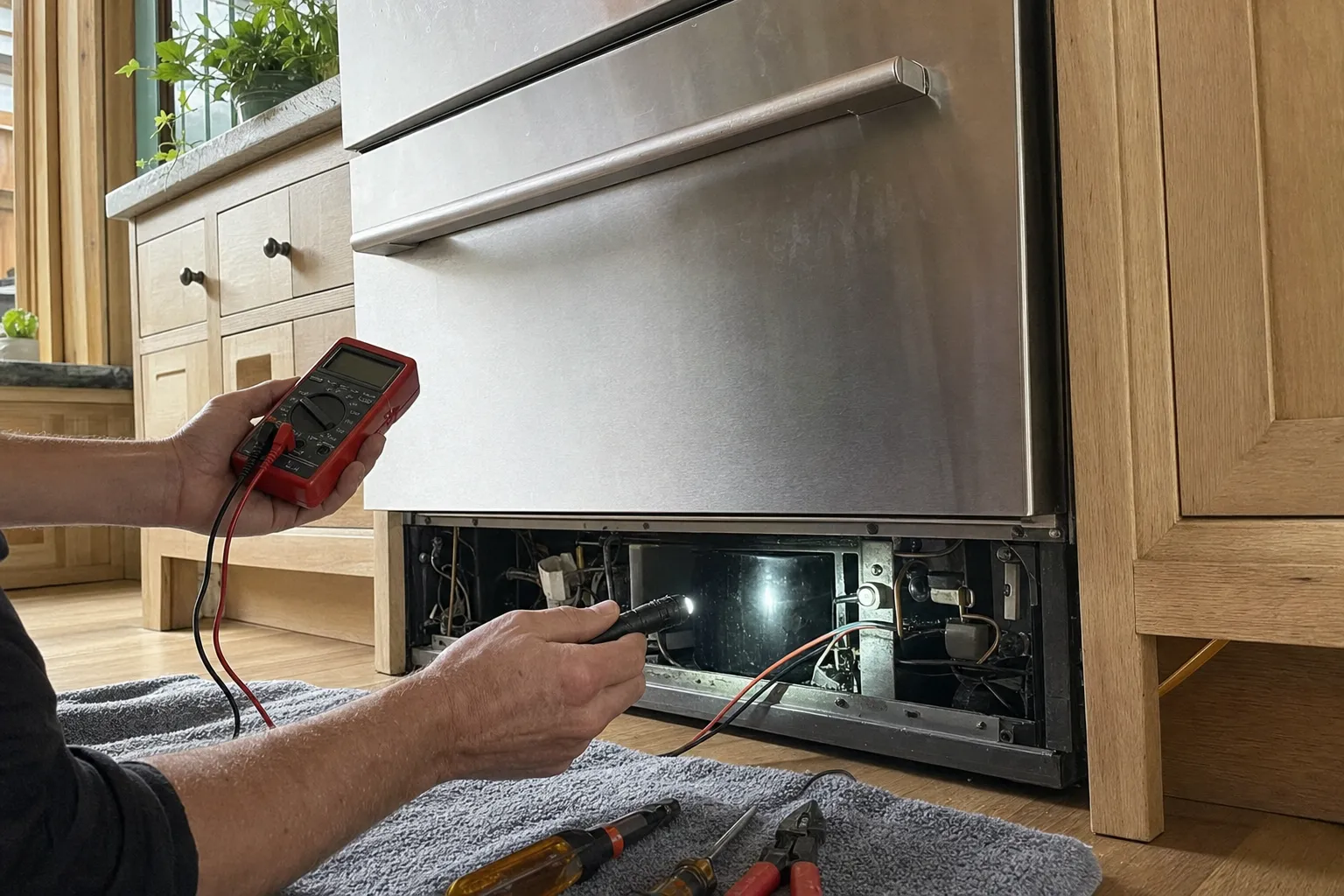
There is a heater wrapped around the evaporator, a terminator or thermal limiter that cuts the heater when the coil reaches temperature, and the control that decides when to run a cycle. In a modern Sub-Zero the control is adaptive: it counts compressor runtime and door openings rather than working on a fixed timer, which is more efficient and slightly harder to fault-find, because there is no fixed interval to compare against.
A failed heater is the most common of the three by a wide margin. It reads open on a meter and produces exactly the symptom described above — steadily worsening back-wall ice, weeks of gradual decline, and a compartment that slowly loses temperature as the coil chokes. A failed terminator is less common and can go either way: stuck open, no defrost at all; stuck closed, and the heater runs too long and the compartment cycles warm on every defrost.
The control board is last on the list and it is worth being blunt about that. Boards do fail, but they get blamed far more often than they deserve, usually because a board is a single part that can be swapped without any real diagnosis happening first. On a unit with a genuine board fault, other things are normally misbehaving too — display, alarms, fan behaviour. A tidy unit with one dead heater is a dead heater.
The seal test, and why island kitchens fail it
If the ice is around the opening rather than on the back wall, the test takes thirty seconds.
Close the drawer on a strip of paper and pull it out. Do it at four or five points along the run — the corners matter most, because that is where gaskets give up first. If the paper slides free without any drag at one spot and grips everywhere else, that corner is the leak.
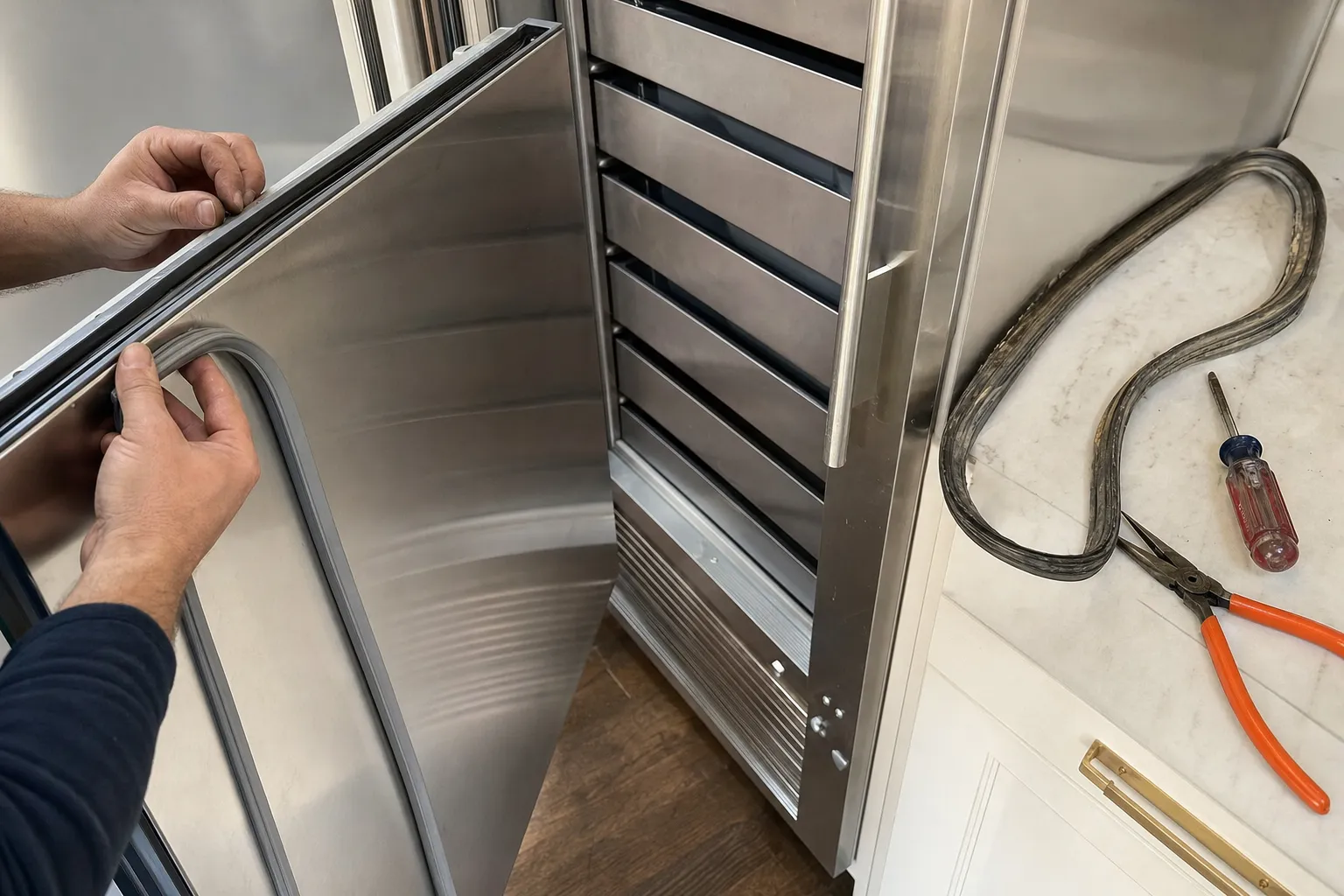
Gaskets on this coast have a specific enemy. Sub-Zero door seals are magnetic strips inside a flexible profile, and what kills them is not age so much as repeated hardening. A kitchen that runs cool overnight and warm in the afternoon is working that profile every day, and over the years it takes a set: the gasket keeps the shape it was crushed into rather than springing back. On a freezer drawer the first sign is the pattern described above, ice along the slides and around the opening.
Island air adds a second problem. The folds of the profile hold whatever damp gets into them, and in a waterfront kitchen that is most days of the year. Grime settles in the wet fold, the fold stops drying, and the rubber either side of it stiffens faster than the rest. That is why the corner that fails the paper test is so often the one nearest the floor, where spills and mopping water reach it.
Sub-Zero’s own advice is to keep gaskets clean, because residue left on them leads to early wear and cracking, and to clean and dry a gasket thoroughly if moisture is seeping from it. Mild soap and warm water on a soft cloth, into every fold, then a dry cloth after it, does that. What it cannot do is mend a split gasket: a rip, tear or crack means replacement, and the manufacturer recommends that a technician fits it.
The good news is that a gasket is a replaceable part rather than the end of the cabinet, and the range for that job is printed on the freezer repair page. The bad news is that people run them years past their useful life, and every one of those years is spent making frost and paying for the extra runtime.
What to do before you book anything
Do these three things and a service call becomes much shorter.
Clear the ice completely — turn the compartment off, empty it, and let it melt onto towels rather than attacking it with anything sharp. A screwdriver through an evaporator turns a heater job into a sealed-system job.
Then, with the drawer empty and clear, stand an appliance thermometer on the floor of the drawer, close it, and read it after four hours. The FDA’s mark for a freezer is 0°F or below. That number tells us whether the compartment still holds temperature once the insulation of the ice is gone. Leave the glass of water out of it here — water in a working freezer freezes, and a thermometer sitting in slush reads about 32°F whatever the compartment is doing.
Finally, note the date and watch. Frost that is visibly back within seven to ten days is a defrost circuit, effectively confirmed. Frost that takes two months to return, in a compartment that holds temperature fine, is a habit or a seal.
Have the model number ready from the product rating plate — the use and care guide shows where the plate sits on your model. Between the model family, the return rate of the frost and one honest temperature reading, most of these calls are narrowed to a specific part before anyone crosses the water — which on Bainbridge is the difference between one visit and two.
Follow-ups we get on this one
- How much frost is normal in a Sub-Zero freezer drawer?
- A light dusting on the food and a thin haze on the drawer sides is normal. A hard sheet on the back wall, ice on the slides, or frost that returns within a week of being cleared is not — that is a defrost or a seal problem.
- If I melt the ice out myself, is that the end of it?
- Only of the ice. Clearing it by hand takes the symptom away for a few weeks while whatever caused it carries on. Do it anyway before a visit, because how quickly the frost returns is one of the most useful things you can tell us.
- Can frost make the freezer run warm?
- Yes, and that is the sequence most people miss. Frost on the evaporator insulates it, the compartment loses temperature, and the unit runs longer to compensate — which makes more frost. By the time the high-temperature alarm sounds, the ice has usually been building for months.
freezerdiagnosticsdefrostgaskets