Wine Cooler Repair · Lynwood Center
Sub-Zero Wine Cooler Zones Drifting Apart on Bainbridge Island
One zone holds, the other creeps three or four degrees warm. On a dual-zone Sub-Zero that is almost never the compressor — here is how to read the symptom before paying for the wrong repair.
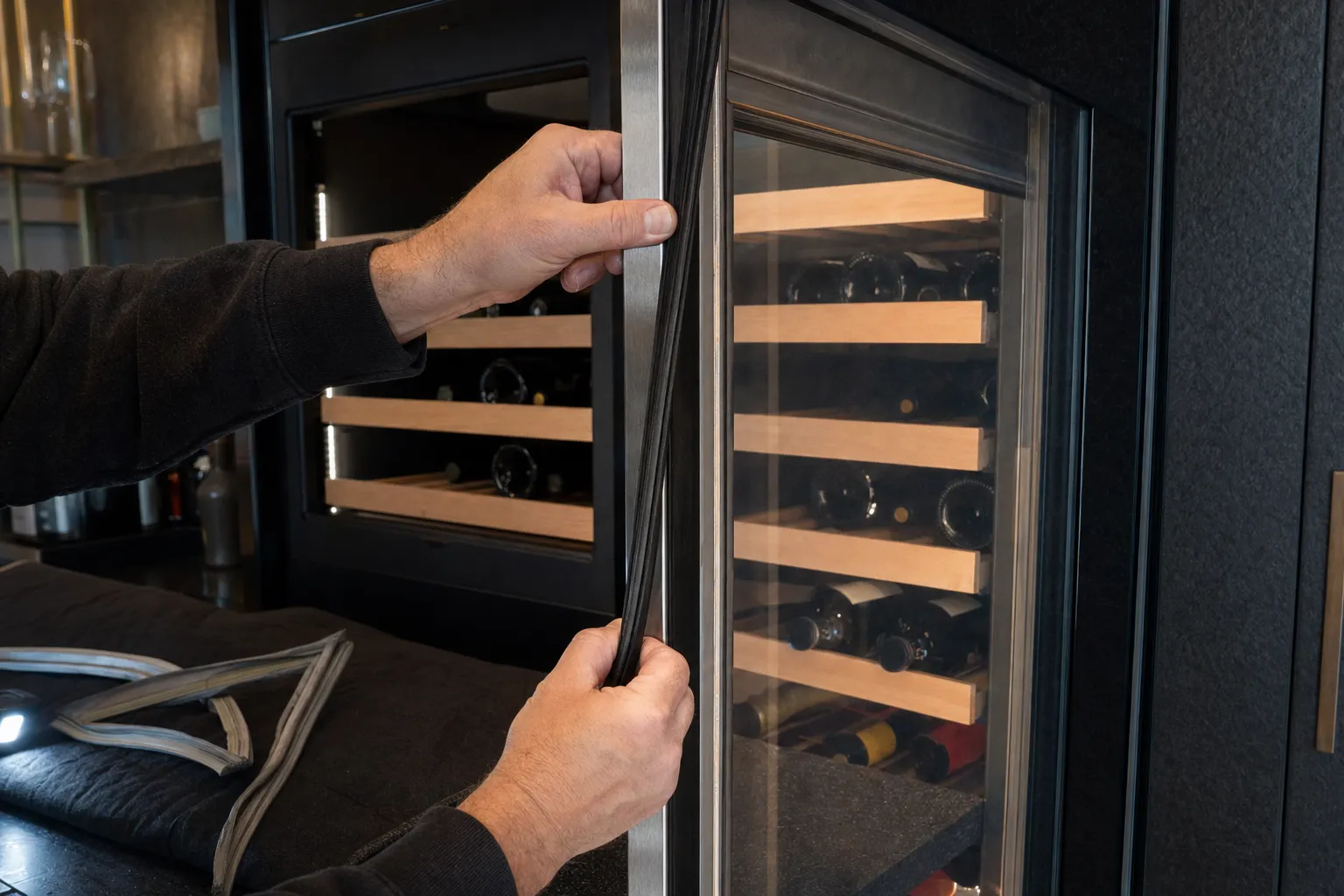
A dual-zone Sub-Zero wine unit that has started running two different stories — one compartment obedient, the other three or four degrees above where it is set — is one of the most misdiagnosed faults in built-in refrigeration. It sounds serious. It reads like a cooling failure. It gets quoted as a compressor, or worse, as a reason to replace the whole cabinet. In practice it is nearly always a sensor, a fan or a damper, and the way to tell is simple enough to do before anyone books a visit.
What a dual-zone unit is actually doing
The important thing to understand is that most Sub-Zero dual-zone wine cabinets do not have two cooling systems. They have one, and they divide its output. A single evaporator produces the cold; a fan and a damper decide how much of it reaches each compartment; and a thermistor in each zone reports back so the control board can adjust.
That architecture matters, because it tells you what a split symptom can and cannot mean. If the sealed system were failing, both zones would suffer. Cold is being made — the zone that is holding proves it. So the fault has to live in the part of the machine that decides where the cold goes, or in the part that reports back on whether it got there.
There are exactly four candidates:
- the zone thermistor, reporting a temperature that is not real
- the damper or its motor, stuck part-way and starving one side
- the evaporator fan, weak or intermittent, so air stops reaching the far zone
- the control board, taking correct readings and acting on them wrongly
The last one is the rarest and by far the most expensive. It is also, depressingly often, the first one quoted.
Prove the drift before anything else
Do not trust the display. The panel reports what the control board believes, and in a sensor fault what the board believes is precisely the thing that is wrong.
Put a glass of water in the middle of each zone with a kitchen thermometer in it and leave the door shut for two hours. Water averages out the door-opening noise that makes air readings jump around, and two hours is long enough for a full compressor cycle to complete.
Then compare three numbers per zone: the setpoint, the panel reading and the thermometer. What you get back is diagnostic on its own.
If the panel agrees with the thermometer and both are above the setpoint, the board knows the zone is warm and cannot fix it — that points at airflow, so the damper or the fan. If the panel reads correctly at the setpoint but the thermometer says otherwise, the board is being lied to, and that is a thermistor. It is a five-minute test that decides which half of the machine anyone should be opening.
Listen to the unit for a full cycle
The second free test is your ears. Stand near the cabinet for twenty minutes with the door closed and note what runs and when.
A healthy unit settles into a rhythm: compressor on, fan up steadily behind it, both running together, both stopping together. What you are listening for is anything that breaks that pattern. A fan that rises and falls at random, or audibly changes pitch under load, is a bearing on the way out, and a fan that has slowed moves less air to the far end of the cabinet. The upper zone, furthest from the evaporator, is always the one that goes hungry first, which is exactly why the top compartment is usually the one drifting.
A faint rattle that appears only during the cooling cycle is more often a loose shroud than a failing motor. It is worth mentioning on the phone either way, because it changes what gets loaded on the van.
Silence with a warm zone is the opposite finding: if nothing is running while a compartment sits four degrees warm, the board has been told everything is fine. Back to the thermistor.
What condensation on the glass adds
Interior condensation gets treated as a separate complaint, and it is not. On Bainbridge, where summer humidity in a waterfront kitchen is high enough to matter, fogging on the inside of the door belongs with the zone reading rather than beside it. Ask what the manufacturer’s troubleshooting asks, in four questions: is the coil clean; is the door pulling itself properly shut; has anyone left it standing open; is the seal split anywhere along its run. Every one of those is also a reason a zone drifts, which is why the two complaints usually arrive together.
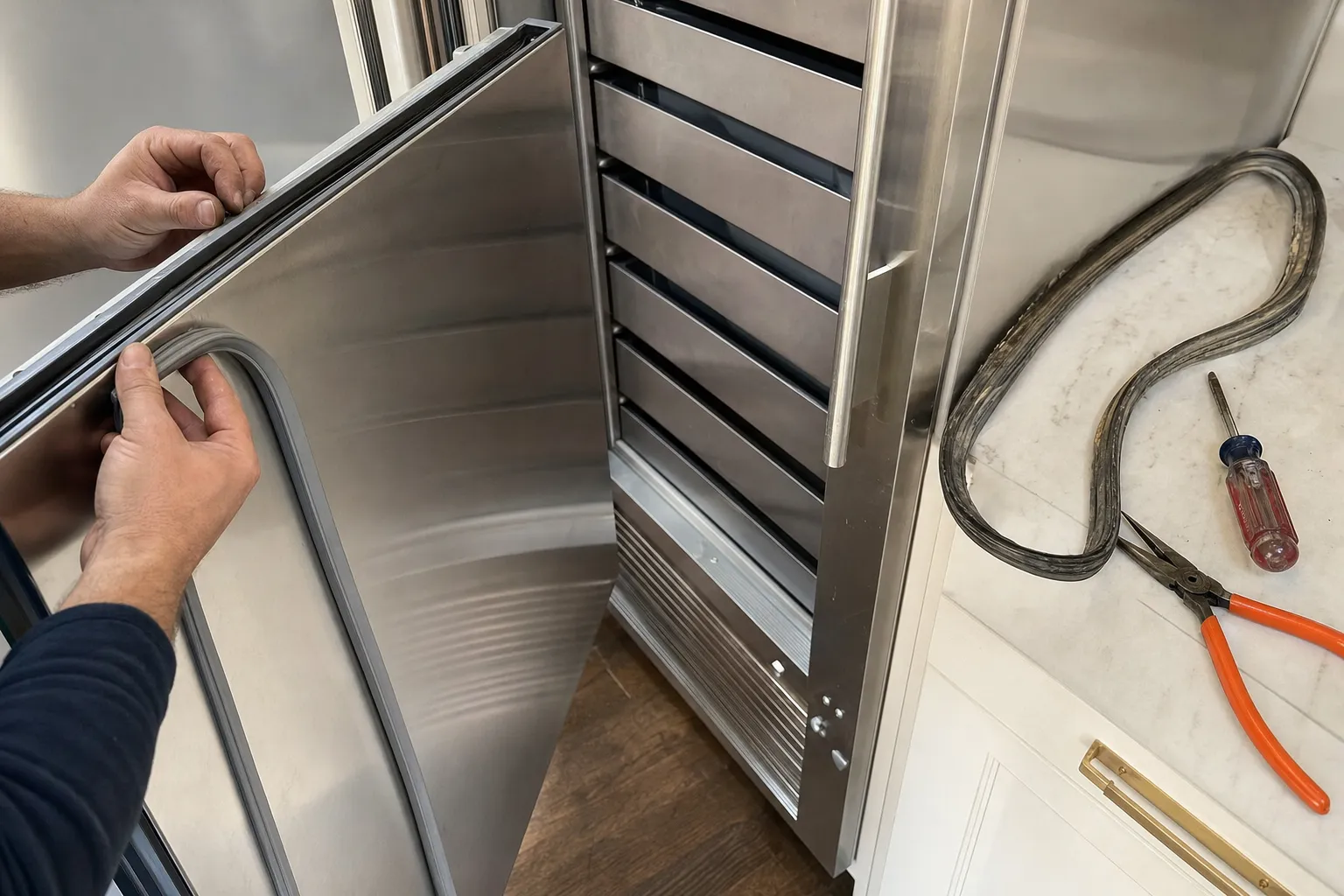
The last two tie straight back to a drifting zone. A gasket that has stiffened or pulled away at a corner loads the whole system with a constant warm-air leak, and the zone nearest that corner is the one that never quite gets there. Run a sheet of paper around the closed door and pull. If it slides out without resistance anywhere along the run, the seal is done at that point — and a seal is a replaceable part, with its range printed on the wine cooler repair page.
When it is worth calling someone
Call when the readings say the panel is lying, when a fan sound has changed, or when the drift is cycling rather than steady. Cycling is what actually damages a collection.
Hold off if the unit was recently moved, recently refilled with room-temperature bottles, or is sitting in a cabinet run with no clearance at the grille. Twenty warm bottles will pull a zone up for two days by themselves, and a blocked base grille produces a drift that no part will fix.
When you do call, have the model number from the product rating plate — the use and care guide shows where the plate sits on your model — and both sets of numbers from the water test. Between them, most of these calls get narrowed to one component before the van leaves — and on an island where a return trip means another crossing, arriving with the right part is most of the job.
Follow-ups we get on this one
- How far apart should the two zones actually run?
- On the current Sub-Zero wine units the two zones leave the factory set at 45°F and 55°F, and either can be changed a degree at a time. Whatever you set, a zone should settle close to it and stay there. A steady three- or four-degree gap between the setting and a thermometer is a fault, not a tolerance.
- Does a warm zone mean the wine is ruined?
- A few weeks at 60°F will not destroy anything. Sustained swings are the real damage — repeated expansion and contraction pushes wine past the cork. If a zone is drifting, the urgency is about stopping the cycling, not about the absolute number.
- Is it worth repairing a fifteen-year-old wine unit?
- Usually yes. The cabinet, the racking and the glass are the expensive parts and they do not wear out. Sensors, fans and control boards are the parts that fail, and all three are replaceable at a fraction of what the unit is worth.
wine storagediagnosticsdual zonesensors