Ice Maker Repair
Sub-Zero Ice Maker Leaking Water? Four Places to Look First
A Sub-Zero ice maker leaking water is almost always fed by one of four sources: the supply line or fill valve, a blocked defrost drain, an undercounter drain set too high, or condensation at a weak door seal. Here is how to tell which one you have.

When a Sub-Zero ice maker leaks, the water nearly always comes from one of four places: the supply line and fill valve that feed the ice maker, the defrost drain and its pan, the drain line on a standalone undercounter ice maker, or moisture condensing around a door that no longer seals. Where the water turns up tells you which one you are dealing with. A drip at the toe kick that gets worse right after a fill points to the supply side; a flat sheet of ice on the freezer floor points to the drain. A built-in Sub-Zero sits flush inside cabinetry, so water that runs behind the panels for a week can swell wood and stain flooring long before anyone notices, which is why tracing the source beats mopping.
Read the puddle before you reach for a towel
Dry everything first. Then tuck a folded paper towel under the front edge of the kick plate, and set a second one flat on the freezer floor. Look again after a few hours, and ideally after the ice maker has cycled once or twice.
| Where the water appears | Most likely source |
|---|---|
| Floor at the toe kick, worse just after a fill | Supply line, fitting or fill valve |
| Ice sheet or puddle on the freezer floor | Blocked defrost drain, or the ice bin left out |
| Floor beside a standalone undercounter unit | Drain tube routed too high, kinked or slow |
| Beads of water on the door edge or cabinet face | Door gasket not sealing, warm air condensing |
| Drips inside the fresh-food section | Water filter not fully seated |
Wet paper only at the front with a dry freezer is a very different repair from a frozen freezer floor and a dry kick plate, so this simple test saves time for whoever ends up fixing it.
The supply side: line, fittings and fill valve
Each time the ice maker wants water, it opens a solenoid valve for a set moment and lets a measured amount into the mold. A cracked compression fitting or a split line behind the unit will weep every time that valve opens, so the leak arrives in bursts rather than as a steady drip. A valve that fails to close fully does something else: the mold overfills, water spills past the tray, and you find either a fused block of cubes in the bin or a slow trickle down to the floor.
House water pressure matters here. Sub-Zero lists the required range as either 20-100 psi or 35 - 120 psi, depending on the model, and it does not supply a gauge, so it recommends having a plumber confirm the reading. Pressure that runs too high strains the valve, while pressure that runs too low keeps it open longer than the control expects. Older Classic built-ins watch for exactly that. A single ice cube icon flashing with no alarm means the fill valve stayed open too long and the ice maker has switched itself off to avoid a flood. Once you have confirmed the shutoff is open and the line is not pinched, hold the Alarm key until CFC appears to clear the fault code.
Every tap on Bainbridge Island draws from groundwater pumped out of the aquifers beneath the island, whether it arrives through a utility system in Winslow or a private well near Port Madison. Minerals carried in well water slowly build up on valve seats and fine inlet screens, and a seat with scale on it is a familiar reason a valve stops closing cleanly.
The defrost drain, and a bin left out
A Sub-Zero freezer defrosts on its own schedule. A heater warms the evaporator, the frost melts, and the water runs down a drain tube to a shallow pan where it evaporates. If that tube freezes solid or clogs with debris, the melt water backs up, refreezes as a sheet across the freezer floor, and can eventually overflow out under the door. A pan that has cracked or shifted sends the water to the floor instead. When the ice keeps coming back after you clear it, the defrost circuit itself may be at fault, and our guide to frost sheets in a Sub-Zero freezer drawer walks through how that circuit is diagnosed.
Rule out a simpler cause first. On Classic (CL) and Designer (DET, DEC) models, the ice maker pauses for 3 minutes after the bin is pulled and then carries on as normal. Leave the bin in the sink to thaw a stuck clump and new cubes fall straight onto the freezer floor, soften with each door opening, and leave puddles that look just like a drain problem. Sub-Zero advises turning the ice maker off whenever the bin will be out for a long spell.
Undercounter ice makers have a drain of their own
A standalone undercounter ice maker behaves differently from the one inside a refrigerator. It rinses its freezing surface and sheds melt water all day, and every drop has to leave through a drain line. The UC-15I, for instance, makes up to 50 lb of ice a day and uses about 1 gallon of water per hour, roughly 24 gallons per day. If the drain is partly blocked, a loop of tubing sags and holds water, or the line was shoved aside during a cabinet project, that water ends up on the floor.
On gravity-drain Designer undercounter models, Sub-Zero caps the height: measured from the bottom of the leveling legs, neither the drain connection nor any leftover tubing may rise more than 7 inches (178 mm). Extra tubing coiled neatly above that height, often the result of someone tidying the cabinet, can stop the drain and make the unit overflow inside. Check that the tube falls steadily downhill with no kinks, and that the house drain it empties into is not sluggish.
Door seals and condensation in a damp climate
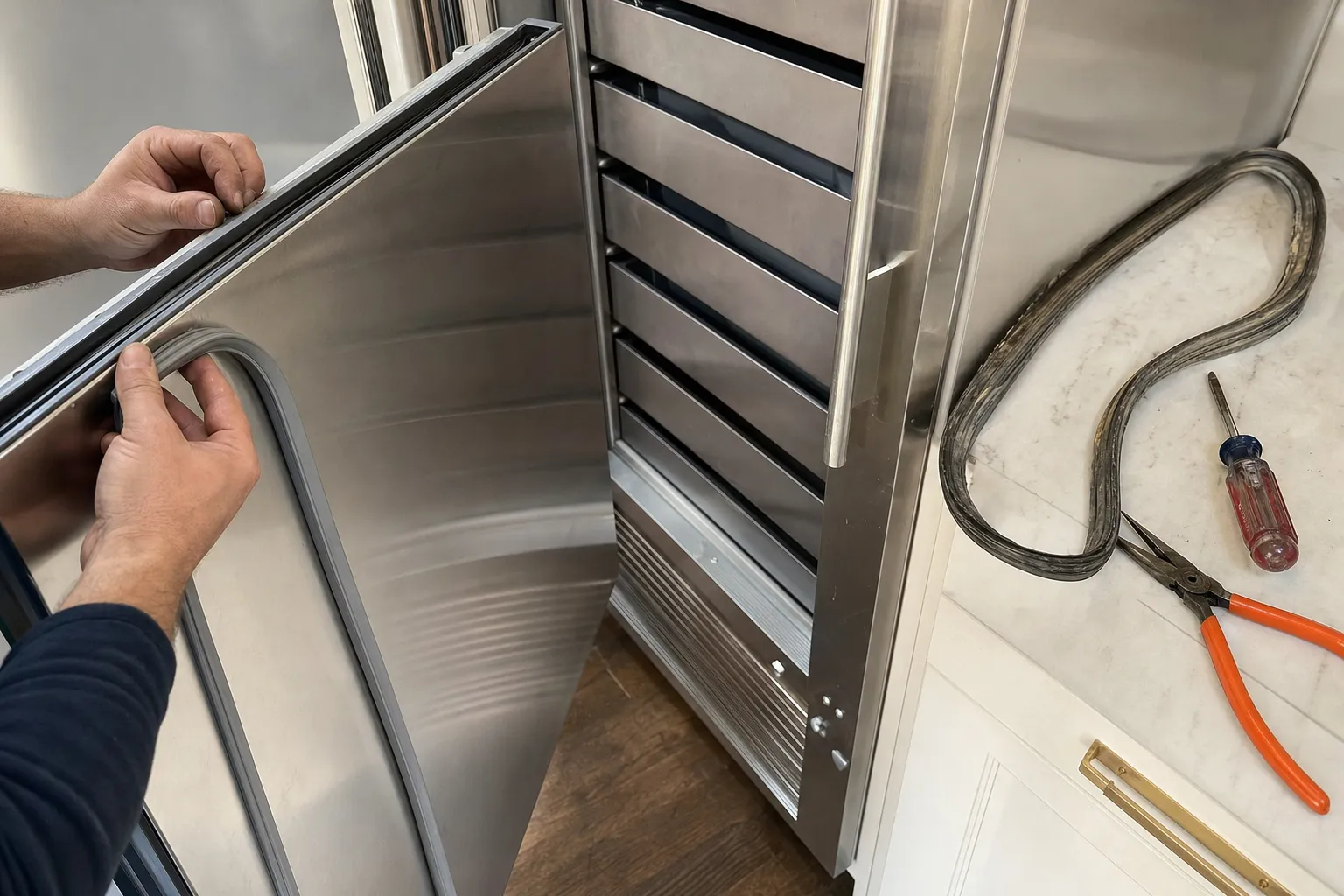
Not every puddle is a plumbing leak. When a door gasket tears, flattens or pops out of its channel, room air slips into the cabinet, and the moisture in it condenses on the cold surfaces near the gap. It then drips down the cabinet face or freezes behind the ice bin. Through the long wet season on Puget Sound there is no shortage of moisture in the air to do this. Run a fingertip around the gasket looking for gaps, then close the door on a sheet of paper at several points along the seal. If the paper slides out with no drag, the seal is not holding. Homes close to the shoreline should also read whether salt air shortens a Sub-Zero’s life, since seals and coils age with exposure.
Safe checks you can make yourself
- Switch the ice maker off at the control. If water is reaching the floor, close the shutoff valve that feeds the refrigerator, but leave the power on so food stays cold.
- Look at the water filter, if your unit has one. Many do not: Sub-Zero notes that its wine storage (other than the IW-30CI), the UC-24 and DEU undercounter refrigeration, and ID drawer models carry no internal filter. On a Classic (CL) unit, lift the grille from its bottom edge and make sure the filter has been turned clockwise as far as it goes; one that missed its final quarter turn can weep.
- After any filter change on a Classic (CL) or Designer (DET, DEC) model without a dispenser, throw away the first two full bins of ice.
- Clear a flashing ice cube fault only after you have checked the supply, so you are not simply resetting a valve that will overfill again.
- On an undercounter unit, confirm the drain tube height and look for kinks behind the toe kick.
If the house will sit empty for a while, the steps in closing up a seasonal house cover shutting off the ice maker water properly.
When the leak needs a technician, and what it costs
Call for service when water appears with the ice maker switched off, when the flashing cube fault returns after you clear it, when the freezer floor keeps icing over, or when you can see water stains on the wall or subfloor. Those signs point to a failing fill valve, a frozen or split drain, or a defrost fault, and none of them is a sensible homeowner job on a built-in unit.
Driftwood Appliance Service charges one flat $89 visit to come out and pin down the fault, and that $89 is taken off the bill when you approve the repair. Fixing the ice maker itself, its water valve or the supply line typically costs $260–$860. A worn door gasket or seal is usually $280–$640 to replace, and a defrost heater, thermostat or sensor $290–$640. Treat those as typical ranges; the firm quote comes once the fault is diagnosed. We cover Winslow, Rolling Bay, Lynwood Center and Port Madison; call (206) 785-2960 or read more about our Sub-Zero ice maker repair work.
Follow-ups we get on this one
- What is the right way to clean and descale a Sub-Zero ice maker?
- Use the built-in cleaning cycle with descaler and sanitizer rather than scrubbing parts by hand. For the Designer undercounter ice maker, the company wants a first clean at startup, then one every three to six months, sooner with harder water; each round takes 1/2 cup descaler and 1/2 tablespoon sanitizer. A UC-15I should be cleaned every six months: press CLEAN, empty its bin, pour in 4 ounces of cleaner once the light flashes, then run it again with 1 tablespoon of sanitizer, about 30 minutes per pass.
- What resets a Sub-Zero ice maker after a fault?
- That depends on the signal on the control. Older Classic built-ins flash a single ice cube, with no alarm, when the fill valve has been shut down to prevent flooding. Once the shutoff and line have been checked, clearing it takes one long press of Alarm, held down until CFC comes up on the display. A UC-15I turns its REPLACE FILTER light red after 8000 ice-making cycles, and once the new filter is in, holding CLEAN for 6 seconds clears it.
- Why is my Sub-Zero not making ice after a leak?
- Usually the control has locked the ice maker out, the shutoff was closed and never reopened, or the water pressure is too low. Open the supply fully and clear any fault code first. For a UC-15I that runs but produces nothing, Sub-Zero says to confirm 20 to 80 psi of water pressure and room air between 50°F and 100°F for the indoor model.
- Can I keep using a Sub-Zero while the ice maker leaks?
- Generally the refrigerator is fine to keep running, but turn the ice maker off at the control and shut the water valve that feeds the unit until the leak is traced. Cooling does not depend on the ice maker, so food stays safe while you wait for a visit, and no more water reaches the cabinetry or floor.
sub-zeroice makerleakswater supply